
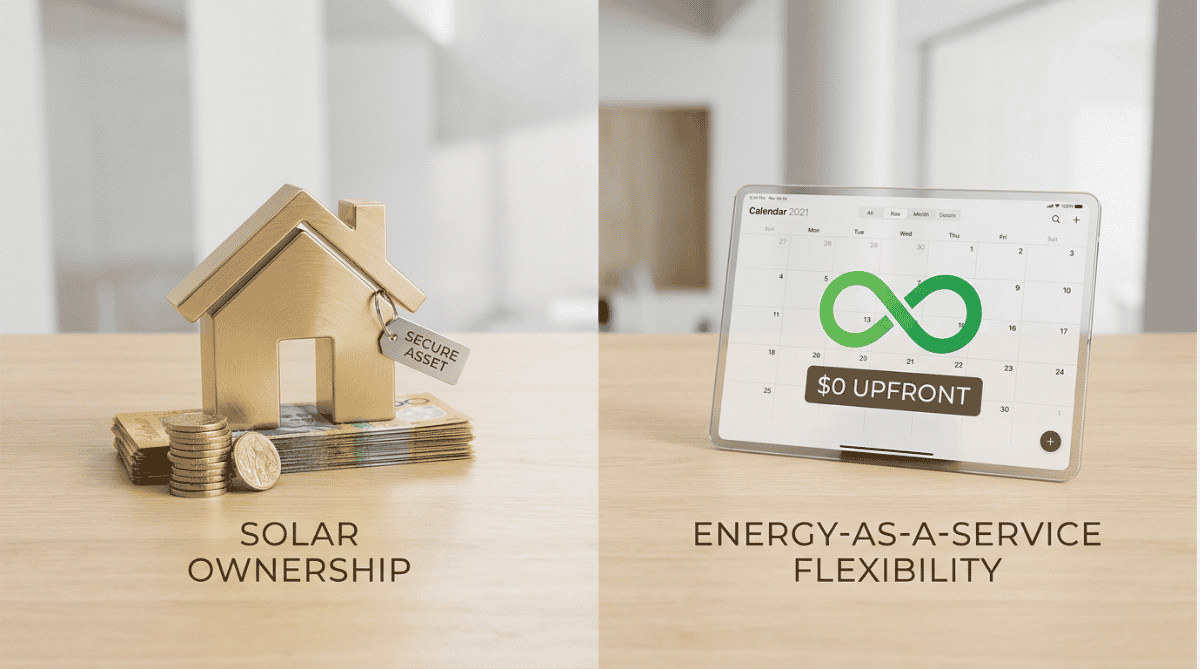
If you’re comparing solar ownership vs energy as a service australia, you’re likely trying to answer one key question: Which option will actually save me more money — and reduce my electricity risk long term? With electricity prices rising across Australia and ongoing wholesale volatility, more households are exploring solar. But the real decision isn’t just whether to install panels; it’s whether you should own the system outright or choose a $0 upfront solar energy plan under a modern Energy-as-a-Service model.
It’s whether you should own the system outright — or choose a $0 upfront solar energy plan under an Energy-as-a-Service model.
Both can reduce electricity bills.
But financially, structurally, and strategically — they are very different.
Let’s break it down properly.
What Is Solar Ownership in Australia?
When you choose solar ownership, you purchase and install the system yourself.
This typically includes:
- 6.6kW–10kW solar system (standard residential size)
- Inverter
- Optional battery (usually 10–13kWh)
Average Solar Battery Cost in Australia
While prices vary by state and installer quality, typical ranges are:
- Solar only: $6,000–$10,000 AUD
- Solar + battery: $15,000–$25,000 AUD
The addition of a battery significantly increases upfront investment but can improve self-consumption and reduce grid reliance.
Is Solar Ownership Worth It in Australia?
It can be — depending on:
- How long you stay in your home
- Your daily energy usage pattern
- Feed-in tariff rates in your state
- Future grid price increases
Most ownership models reach break-even within 4–8 years, after which savings accumulate.
Advantages of Solar Ownership
- Full system ownership
- Potential long-term ROI after payback
- Ability to benefit from feed-in tariffs
- No contract dependency
Risks of Solar Ownership
When comparing solar ownership vs energy-as-a-service in Australia, ownership carries:
- $15k–$25k capital commitment
- Inverter replacement after ~10–15 years
- Battery degradation over time
- Feed-in tariff reductions
- Retail electricity price volatility
- Responsibility for system performance
Ownership can deliver higher theoretical returns — but only if:
- Technology performs as expected
- You stay long enough to recover capital
- Policy settings remain favourable
What Is Energy-as-a-Service in Australia?
Energy-as-a-Service (EaaS) is a structured model where:
- The provider installs and owns the solar + battery system
- You pay for electricity at an agreed rate
- Maintenance and performance risk remain with the provider
It is often referred to as:
- Solar PPA Australia
- $0 upfront solar Australia
- Solar subscription model
How a $0 Upfront Solar Energy Plan Works
Under Energy-as-a-Service:
- No installation cost
- No equipment ownership
- No maintenance liability
- No performance management required
- Electricity billed at a fixed or structured rate
Instead of investing $20,000 upfront, you convert energy into an operating expense — often at a predictable rate.
This fundamentally changes the risk profile.
10-Year Financial Comparison: Solar Ownership vs Energy-as-a-Service in Australia
Let’s use a realistic household example.
Assumptions:
- Annual consumption: 7,000 kWh
- Grid rate: 30–40c per kWh
- Solar + battery ownership cost: $18,000
- Energy-as-a-Service model: fixed electricity rate Australia
Scenario 1: Solar Ownership
Year 0:
- $18,000 capital outlay
Years 1–5:
- Savings accumulate
- Break-even typically 5–7 years
Years 6–10:
- Potential strong net savings
- Maintenance & component risk
Ownership can generate greater lifetime returns — but only after absorbing initial capital risk.
Scenario 2: Energy-as-a-Service
Year 0:
- $0 upfront
Years 1–10:
- Immediate savings (if below grid rates)
- No maintenance exposure
- No inverter replacement risk
- Predictable electricity cost
This model prioritises:
- Cashflow
- Risk reduction
- Cost stability
Rather than asset appreciation.
Risk Breakdown: Financial & Technical Comparison
When evaluating solar ownership vs energy-as-a-service in Australia, the risk transfer is one of the biggest differences.
Ownership Risks
- Technology obsolescence
- Battery degradation
- Inverter replacement cost
- Policy changes
- Feed-in tariff reductions
- Retail electricity rate exposure
Energy-as-a-Service Risks
- Contract duration
- Provider stability
- Rate structure transparency
Ownership concentrates technical and financial risk on the homeowner.
Energy-as-a-Service transfers most of it to the provider.
Cashflow vs ROI: The Hidden Financial Factor
Many comparisons focus purely on ROI.
But in Australia’s current economic environment, cashflow matters.
Ask yourself:
- What is the opportunity cost of $20,000?
- Could that reduce mortgage interest instead?
- Could it remain invested elsewhere?
- How valuable is liquidity?
Solar ownership may generate higher long-term returns.
Energy-as-a-Service may generate higher financial flexibility.
For many households, flexibility is the real saving.
Who Should Choose Solar Ownership?
Solar ownership may be better if:
- You have available capital
- You plan to stay 10+ years
- You want full asset control
- You accept maintenance responsibility
- You prioritise maximum long-term ROI
Who Benefits Most from Energy-as-a-Service in Australia?
Energy-as-a-Service may be better if:
- You prefer $0 upfront solar in Australia
- You want predictable electricity pricing
- You value convenience
- You want no maintenance responsibility
- You prioritise immediate financial benefit
- You prefer structured energy cost over asset ownership
For households concerned about volatility and rising grid rates, predictability can outweigh theoretical ROI.
Environmental Impact: Is There a Difference?
From a sustainability perspective:
- Both models reduce reliance on fossil-fuel-heavy grid electricity
- Both support renewable energy adoption
- Both reduce household carbon emissions
The difference is financial structure — not environmental impact.
Final Answer: Which Saves More?
When comparing solar ownership vs energy-as-a-service in Australia, the answer depends on your priorities.
Solar ownership may save more over 15–20 years if:
- You stay long-term
- The system performs optimally
- You recover your capital
Energy-as-a-Service may save more in practical, real-world terms if:
- You want zero upfront cost
- You value cashflow
- You prefer predictable electricity costs
- You want reduced risk
The better question isn’t:
“Which model has the highest theoretical return?”
It’s:
“Which model gives me the most control over my financial risk and energy costs?”
Want to Compare Your Real Numbers?
The most accurate way to decide is simple:
- Compare your current electricity rate
- Calculate your annual consumption
- See what a $0 upfront solar + battery energy plan would look like for your home
Because energy decisions shouldn’t just be about panels.
They should be about certainty.