
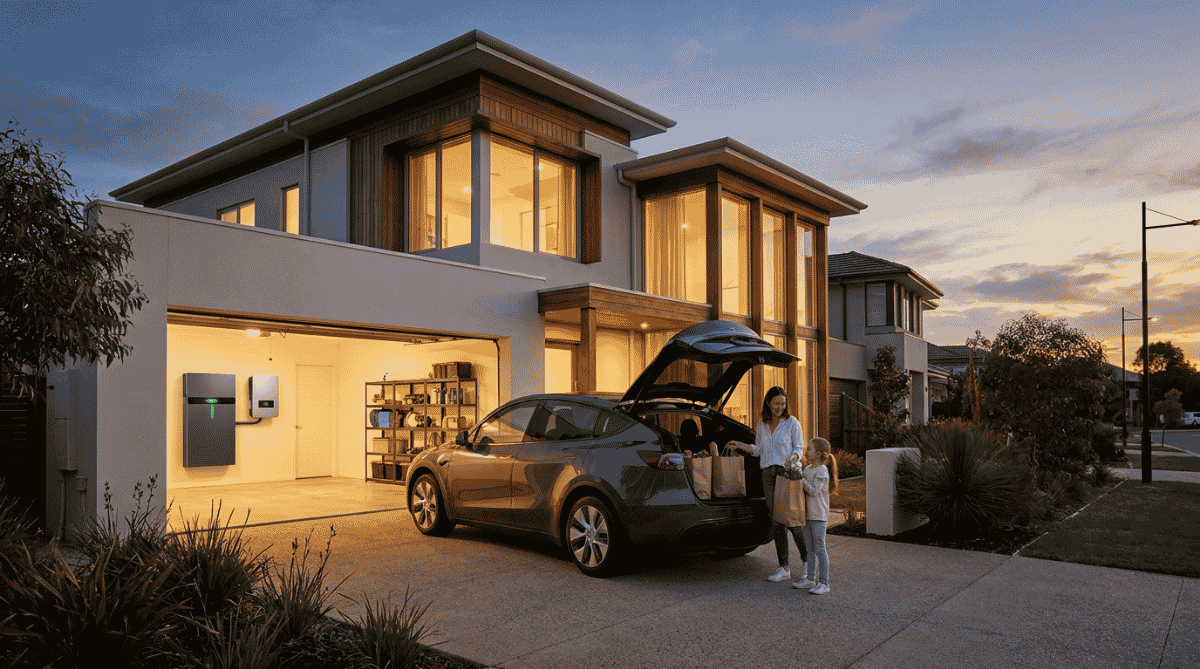
Solar battery vs no battery is the question every Australian homeowner ends up asking right before signing a quote. Five years ago the answer was usually “skip the battery, they’re too expensive.” In 2026 that answer has flipped for most households. Here’s why, and how to know which side of the line you sit on.
This guide walks you through the actual numbers, the scenarios where battery is essential, the ones where it’s optional, and the rare cases where you genuinely shouldn’t bother.
Why the Maths Changed
Three things have shifted in the last five years to push the battery decision in a new direction:
Feed-in tariffs have collapsed. Most Australian retailers paid 12-15 cents per kWh exported back in 2020. By 2026 most pay 4-8 cents — and some have introduced peak-export charges where you pay to export during over-supply hours.
Retail electricity prices have climbed. Peak grid rates in QLD, NSW, VIC, and SA now sit around 35-45 cents per kWh during evening hours. That gap between import and export prices is what makes batteries valuable.
Battery costs have dropped, and rebates expanded. The federal Cheaper Home Batteries Program (started mid-2024) covers roughly 30% of battery cost up to a cap. Combined with falling manufacturer prices, a 10kWh battery installed today costs around 35-40% less than the same battery five years ago.
The combined effect: a battery that paid back in 12-15 years in 2020 often pays back in 6-8 years in 2026.
The Core Trade-Off in One Sentence
Without a battery, you’ll capture roughly 30-40% of your solar production directly. With a battery, you’ll capture 75-90%.
Everything else flows from that single number. The unused portion either gets exported at low rates (no battery) or stored for evening use at high effective value (with battery).
For a household using 20 kWh a day, that’s the difference between $1,200/year savings and $2,200/year savings on a similar-sized system.
When You Almost Certainly Need a Battery
Five scenarios where the answer is clearly “yes”:
- You’re empty during the day. If everyone’s at work or school 9am-5pm, your daytime self-consumption is tiny. Without a battery, almost all your solar goes to the grid at 5-8 cents. With a battery, it powers your evening at 35-45 cent grid prices.
- Your evening usage is heavy. Aircon-on, dinner-cooking, TVs-running, kids-charging-devices households burn most of their power between 5pm and 10pm. Solar without battery doesn’t help with any of that.
- You live somewhere with frequent outages. QLD storm season, NSW bushfire-zone outages, SA wind events — if you’re losing power more than twice a year, blackout protection from a battery is a real quality-of-life upgrade.
- You’re planning to add an EV. A typical EV adds 5-12 kWh of evening charging demand. Without a battery, that’s grid energy at peak rates. With a battery, it’s stored solar from earlier in the day.
- You want predictable bills. Batteries reduce your reliance on grid-pricing volatility. As the AER continues approving retail price rises, batteries become an inflation hedge.
When You Genuinely Can Skip the Battery
Three scenarios where solar-only still makes sense:
- You’re home all day with low evening use. Retirees who watch daytime TV, work-from-home parents who do most laundry and cooking before sunset — if your usage pattern matches solar’s generation pattern naturally, you don’t need to shift much. Solar alone captures most of the value.
- Your usage is very low. A 1-person home using 6-10 kWh a day generates enough solar in 2-3 hours of sun to cover the day. A battery wouldn’t have enough loads to discharge into to pay back.
- You’re testing the waters. Some homeowners install solar this year and plan to add a battery in 2-3 years when prices drop further. This works fine as long as you specify a battery-ready (hybrid) inverter on the original install — otherwise you’ll pay twice when you add storage.
A Real-Life Scenario: Two Households, Same System Size
Picture two Sydney families. Both install a 6.6kW solar system. Both spend $7,500 after rebates. Their bills behave very differently.
Family A (no battery, empty during day). Both parents work, kids at school, daytime usage averages 3 kWh. Their 6.6kW system generates 26 kWh on a good day. They self-consume 3 kWh, export 23 kWh at 6 cents = $1.38 in feed-in credits. That evening they buy back 16 kWh at 38 cents = $6.08 in grid power. Net daily benefit from solar: about $4.70.
Family B (no battery, home all day). One parent works from home, three loads of laundry a day, dishwasher runs at midday, school holidays mean kids are home. Daytime usage averages 14 kWh. They self-consume 14 kWh of solar (avoiding 14 × 38c = $5.32 in grid purchases), export 12 kWh at 6c = $0.72. Net daily benefit: about $6.04.
Now add a 13kWh battery to Family A’s system, costing an extra $9,000 after rebate. Their daily benefit jumps to roughly $9.50 — almost double. Battery extra cost recovers in about 5 years. After that, pure gain.
Family B sees less benefit from adding a battery because they already self-consume so much directly.
Which household are you?
How Much Battery Do You Actually Need?
The most common sizing mistake: too small. A 6.6kW solar system on a sunny day in QLD generates 25-28 kWh. A 6kWh battery fills in 2-3 hours and then exports the rest to grid at low rates. The system’s potential is wasted.
Realistic battery sizing by usage:
- Daily usage 10-15 kWh: 8-10 kWh battery
- Daily usage 15-25 kWh: 10-13 kWh battery
- Daily usage 25+ kWh, or EV charging: 13-20 kWh battery
For broader context on sizing the whole system to your home, see our solar payback period in Australia guide which covers how battery size affects total economics.
What About Backup Power?
A battery doesn’t automatically give you blackout protection. You need a backup-capable inverter and (usually) a switching device that isolates your home from the grid during an outage. Some battery brands include this; some require additional hardware.
If blackout protection matters to you, ask installers specifically: – Does this system keep working during a grid outage? – Which circuits remain powered (whole home or essential loads only)? – Is the switchover automatic or manual?
Cheaper battery installs sometimes skip backup capability entirely. Verify before signing.
Where Tesseract ZERO Fits In
Tesseract ZERO’s standard package is built around 20kWh of battery storage — larger than the typical 10-13kWh battery most competitors install. The extra capacity matters more in 2026 than it did five years ago, because evening loads (aircon, EVs, electric hot water) have grown while feed-in tariffs have shrunk. The package also includes a Power Backup Gateway for blackout protection, installed at $0 upfront, $0 maintenance, fixed $0.28/kWh through our retail partner for 10 years. For households who’d otherwise be deciding between a 10kWh and 13kWh battery, the 20kWh capacity bundled in this model is worth comparing.
The Bottom Line
Solar battery vs no battery in Australia 2026: for most households, battery is now the better economic choice, not the optional luxury it was five years ago. Feed-in tariffs are too low, grid prices too high, and the gap between the two is exactly what storage captures. The exceptions are real but narrow: you’re home all day, your usage is small, or you’re staging the install with a battery-ready inverter for later.
If you’d like us to model both options against your last four bills, book a free assessment and we’ll show you the numbers side by side.
For a broader look at how affordability and ownership models interact, our affordable solar systems in Australia guide covers the cost-vs-quality trade-off and the no-upfront alternatives.
Frequently Asked Questions
Is a solar battery worth it in 2026?
For most Australian households with quarterly bills above $400, yes. The combination of low feed-in tariffs, high peak grid prices, and the federal Cheaper Home Batteries rebate has shifted the maths firmly in battery’s favour. The clearest exceptions are very small households and homes occupied all day.
Can I add a battery later if I install solar now?
Yes, but only if your inverter is battery-ready (hybrid). Specify this on the original install. Adding a battery later to a non-hybrid system means replacing the inverter — paying twice for the same component.
How long does a home battery last in Australia?
Most lithium iron phosphate (LFP) batteries used in Australian home installations are rated for 10-15 years of useful life, with 6,000-10,000 cycle warranties. Real-world performance often exceeds this for households cycling once per day.