📋 In this guide:
- Cost to charge an EV at home: roughly $5/100 km
- That assumes a 30¢ per kWh electricity rate
- Evening peak charging can nearly double the cost
- Free Solar Sharer hours can cut midday charging costs
- Tesseract ZERO starts by modelling your actual usage
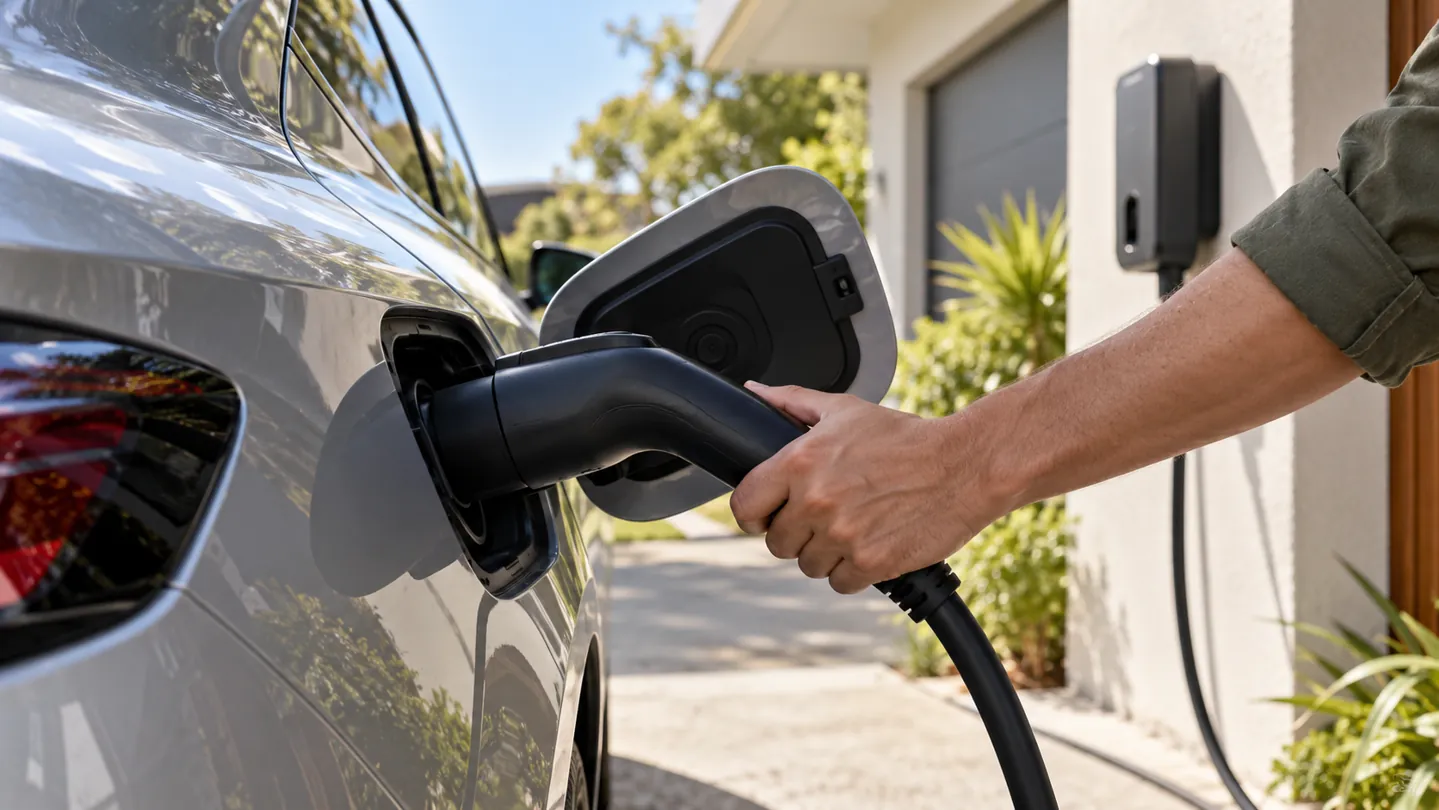
Thinking about an electric vehicle? One of the first questions is simple: what’s the cost to charge an EV at home? The short answer is that it depends less on the car and more on when you plug it in. The same drive to work can cost almost nothing, or twice as much as it should, depending on the hour.
This guide runs through the real numbers for Sydney and Adelaide households: how much energy an EV uses, what that costs at different times of day, and how to make home charging as cheap as possible.
How Much Energy Does an EV Use?
EVs are measured in kilowatt-hours (kWh) per 100 km, much like fuel economy in litres per 100 km. Solar Calculator’s examples put two popular models at:
- Tesla Model Y RWD: about 15.7 kWh per 100 km
- BYD Seal Dynamic: about 16.6 kWh per 100 km
The average Australian car travels about 12,100 km a year, according to the same source. That’s roughly 1,900 to 2,000 kWh of charging a year for a typical mid-size EV.
What It Costs at Different Times
Here’s where timing matters. Using those two example cars:
| Charging rate | Per 100 km | Per year (12,100 km) |
|---|---|---|
| 30¢ per kWh (Solar Calculator’s baseline) | about $4.71–$4.98 | about $570–$603 |
| Peak grid rate of up to 56¢ per kWh | about $8.79–$9.30 | about $1,064–$1,125 |
| Free Solar Sharer window | $0 for energy within the daily cap | depends on how much you can charge midday |
Figures derived from Solar Calculator’s consumption and distance data. Your costs depend on your plan, car and driving.
The difference between charging at the wrong time and the right time can be around $500 a year.
The Evening Trap
Take a commuter in Ryde who gets home at 6pm and plugs in straight away, because that’s what feels natural. Every kWh goes into the car right in the middle of the evening peak. The car is ready by morning, but the bill quietly carries the most expensive charging of the day. Sound like a habit you’d fall into?
Most EVs and home chargers let you schedule charging. Setting a start time outside the peak window is the single easiest saving an EV owner can make. Our guide to time-of-use electricity in NSW explains when Sydney’s peak applies.
The Midday Opportunity
Since 1 July 2026, retailers in NSW and SA must offer at least one Solar Sharer plan with free power in the middle of the day: 11am to 2pm in NSW and 12pm to 3pm in SA, up to 24 kWh a day, according to SolarQuotes’ summary of the rules. That cap alone could cover roughly 145 to 155 km of driving for the example cars.
The catch is being home with the car. A standard 10-amp power point delivers roughly 2.3 kW (10 amps at 230 volts), so three free hours would add only about 40 km of range. A dedicated wall charger delivers far more. Households with someone at home during the day, or a second car that stays put, get the most from midday charging. Our Solar Sharer Offer guide covers the trade-offs, including higher peak rates on some plans.
Tips to Charge for Less
- Schedule charging away from the evening peak.
- Charge at midday whenever the car is home, especially on a Solar Sharer plan.
- Top up little and often rather than charging from empty every night.
- Check your plan once you have an EV. Your usage pattern will change, so the best plan may change too.
- Factor the EV into any energy decision. Adding 2,000 kWh a year changes how you should size solar or storage.
How Is Tesseract ZERO Different?
An EV adds a big new load to your household, and the time of day it charges matters a lot. Tesseract ZERO is a third way to energy: we install solar and battery technology at your home, own it and manage it, so your home generates clean energy during the day and stores it for later, importing less electricity from the grid.
You pay a fixed 28¢ per kWh for the clean energy your home uses, fixed for the 10-year agreement term, with $0 upfront. Whatever your household looks like, we’ll model your actual usage and show you the numbers. Learn more on the Tesseract ZERO page.
FAQ
How much does it cost to charge an EV at home in Australia?
Using Solar Calculator’s figures, a mid-size EV costs about $4.71 to $4.98 per 100 km at 30¢ per kWh, or roughly $570 to $603 a year for 12,100 km. Charging at peak rates of up to 56¢ per kWh can nearly double that.
When is the cheapest time to charge an EV at home?
Usually the middle of the day, when rooftop solar floods the grid. Solar Sharer plans in NSW and SA offer free power in a three-hour midday window.
Can I charge my EV from a normal power point?
Yes. A standard 10-amp power point works but adds range slowly, roughly 13 to 15 km per hour of charging for a mid-size EV. A dedicated wall charger is much faster.
Conclusion
The cost to charge an EV at home can be very low or surprisingly high, and the difference is mostly timing. Charge away from the evening peak, use midday power whenever you can, and build the car’s energy use into your household plans from day one.
Thinking about how an EV fits into your home energy? Send us one power bill. No cost, no obligation — and if it isn’t a good fit, we’ll tell you. Get in touch.
How is Tesseract ZERO different?
Clean energy made at your home, without buying the system.
Tesseract installs, owns and maintains solar and a battery at your home. You pay only for the clean energy you use, at one fixed rate for 10 years.