
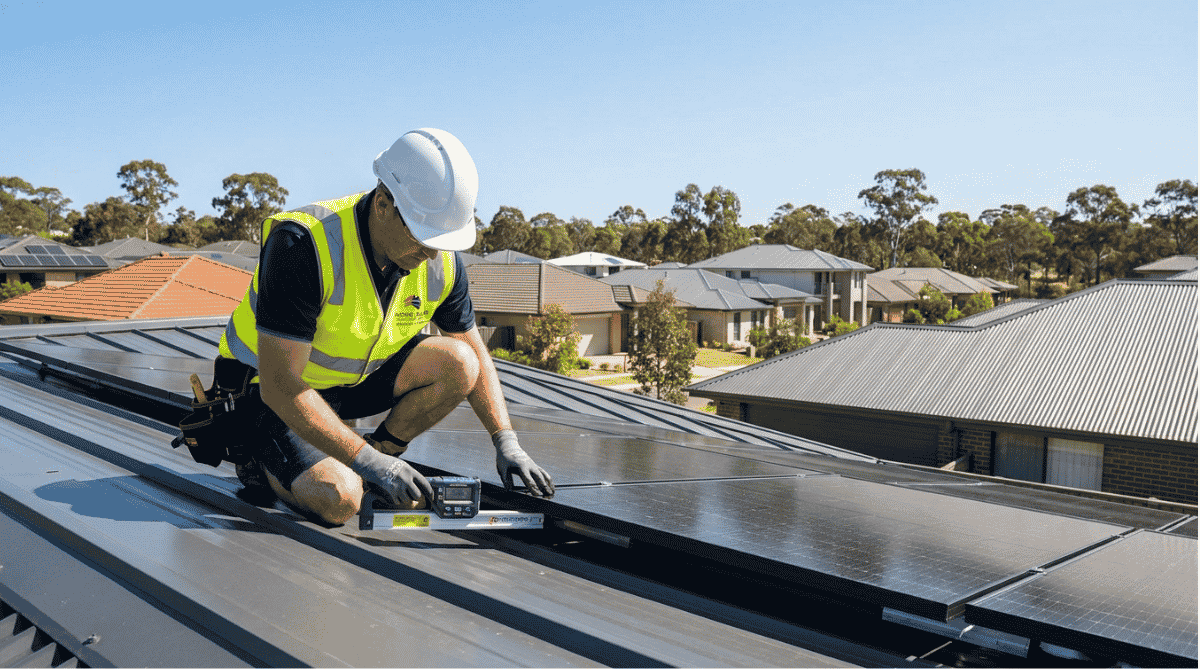
Working out how to choose a solar installer in Australia is the most underrated decision in the whole solar journey. You’ve decided solar makes sense. You’ve collected a couple of quotes. The numbers don’t match, the warranties don’t match, and one installer claims they can finish in two days while another quotes five weeks. So how do you pick without rolling the dice?
The panels you choose matter. The inverter you choose matters more. But the installer matters most — because a mediocre installer can ruin a premium system, and a great installer can stretch a budget system to last twice as long.
Here are the nine questions to ask, the warning signs to spot, and a frame for thinking about whether you should even pick an installer at all.
Why Choosing the Wrong Installer Costs More Than You Think
The Clean Energy Regulator estimates around 6-8% of residential solar systems develop preventable faults in the first five years — almost all traceable to installation quality, not equipment. Common consequences:
- Roof leaks from poor flashing or penetration sealing
- Inverter overheating from bad ventilation choices
- DC arc faults from undersized cabling
- Warranty rejection because the installer cut corners on documentation
When something goes wrong, the manufacturer’s warranty often won’t cover it — they blame the installer. The installer might be out of business. You’re left holding a $20,000 system you can’t fix.
That’s why this decision matters more than panel brand or inverter brand combined.
9 Questions Every Homeowner Should Ask Before Signing
Run every quote you receive through these:
- Are you CEC-accredited? This is non-negotiable. Without CEC accreditation, you can’t claim federal STCs, and the install isn’t compliant.
- Who actually installs the system — your team or a sub-contractor? Sub-contracted installs aren’t automatically bad, but you want to know who’ll be on your roof and what their training looks like.
- What’s the workmanship warranty length? The Australian standard is 5 years. Premium installers offer 10-25 years. Anything under 5 years is a yellow flag.
- What inverter brand and panel tier are in the quote? Tier-1 panels and reputable inverters (Fronius, SMA, Sungrow, GoodWe) are baseline. If the brands aren’t named, ask why.
- What happens if the inverter fails in year 7? This is the single most important question. The honest answer reveals whether the installer will still be there.
- Have you done installs in my street or suburb? Local installs are cheaper for the installer (less travel) and easier to support post-install. Bonus if they can show you a recent job.
- Do you handle the rebate paperwork and grid connection? They should. If they want you to do it, that’s a price-cutting trick that usually leads to delays.
- What’s not in this quote? Switchboard upgrades, scaffolding for two-storey homes, three-phase upgrades — these are common add-ons. Get them in writing now, not after the install starts.
- Can I see three customer references from the last 12 months? Reputable installers will give you names and numbers. Sketchy ones won’t.
CEC Accreditation, Tier-1 Panels, and What These Labels Actually Mean
These three labels get thrown around in every quote, but they don’t mean what most homeowners assume.
CEC accreditation applies to the installer (specifically, the lead electrician on the install) — not the company. So a “CEC-accredited company” might just have one accredited installer covering twenty installs at once. Ask who specifically will be at your home.
Tier-1 panel is a Bloomberg financial classification, not a quality grade. It tells you the manufacturer is financially stable enough to honour 25-year warranties — a useful signal, but not a guarantee of quality. A Tier-1 panel can still be a low-end product within that brand’s range.
“10-year inverter warranty” is usually parts-only, not labour. So if your inverter fails in year 8, you might get a free replacement unit but pay $400–$800 in callout and reinstall fees. Ask whether the warranty includes labour.
Red Flags: Quotes That Look Cheap But Aren’t
Watch for these:
- Quotes 30%+ cheaper than the rest — almost always means cheaper inverter, cheaper panels, or shortened warranty
- Pressure to sign today — legitimate installers don’t pressure homeowners; the quote is valid for 30+ days
- Cash-only or “off-the-books” discounts — voids your STC eligibility and warranty
- No physical address or only a mobile number — companies that vanish don’t have offices
- Vague brand names — “premium imported panels” without a brand name usually means low-tier Chinese imports
- No contract for the warranty — verbal promises are worthless when the installer disappears
A real-life scenario: imagine you’re choosing between a $7,500 quote and an $11,200 quote for a 6.6kW system. The cheap quote uses an unbranded inverter with a 5-year warranty and a 5-year workmanship warranty. The pricier quote uses a Fronius inverter with a 10-year warranty and a 25-year workmanship warranty. Over 25 years, the cheap quote will likely require two inverter replacements ($2,500 each) and you may pay roof repair costs out of pocket. The “expensive” quote often becomes the cheaper option by year 12.
Which quote is actually cheaper? Probably not the one with the smaller number on the front page.
Warranty Reality Check — Who Pays When Something Breaks?
There are usually four warranties on a solar system:
- Panel performance warranty (25 years) — covers efficiency degradation
- Panel product warranty (10-15 years) — covers physical defects
- Inverter warranty (5-10 years) — covers electronics failure
- Workmanship warranty (5-25 years) — covers install errors
When something fails, the diagnosis determines who pays. Was it the panel? The manufacturer. Was it the install? The installer. Was it the inverter? The inverter brand. If your installer disappears, the manufacturer often refuses to honour the panel warranty because the install can’t be verified.
This is why the installer’s longevity matters as much as the equipment quality. Our broader guide on solar energy cost in Australia breaks down the long-term financial impact of warranty gaps.
Installer vs Energy-as-a-Service Provider — Different Beasts
Here’s a reframe most homeowners miss: when you hire a traditional installer, you’re buying a product. When you sign with an Energy-as-a-Service provider, you’re buying a service.
The product model means you own everything and bear all the risk — equipment failure, warranty disputes, inverter replacement, eventual decommissioning. The service model means the provider owns the gear, handles maintenance, and replaces components as they age. You pay only for the energy.
Neither is inherently better. The right choice depends on whether you’d rather hold an asset or hold a contract. We covered this trade-off in our post on solar ownership vs energy-as-a-service.
How is Tesseract ZERO different in this regard?
Tesseract sits on the service side of the line. You don’t choose installers, panels, or inverters — we install our standard package (6.6kW solar + 20kWh battery + Power Backup Gateway) and we own all the equipment for the 10-year contract term. Maintenance, inverter replacement, and warranty disputes are our problem, not yours. The trade-off: you don’t get to pick brands. The benefit: there’s no installer-disappears scenario, because the company maintaining your system is the same one billing you for energy. For homeowners who’d rather skip the nine-question filtering process, that’s the appeal.
Conclusion
How you choose a solar installer in Australia comes down to two things: filtering out the ones who’ll be gone in year five, and matching the right ownership model to your appetite for risk. Ask the nine questions above. Trust references over sales pitches. Read warranties like contracts, because they are.
If you’d rather skip the comparison shopping entirely and look at a fully-managed alternative, book a free assessment and we’ll show you the maths against your current quotes.
If you’re earlier in the journey and still working out whether solar fits your home at all, start with our practical guide to solar energy for your home.
Frequently Asked Questions
How long should a solar quote be valid for?
Most reputable installers in Australia hold quotes for 30 days. If a quote expires in 24-72 hours and the installer pressures you to sign immediately, that’s a red flag. Pricing on quality systems doesn’t fluctuate that fast.
What if my installer goes out of business after the install?
The panel and inverter manufacturer warranties still apply, but workmanship issues become much harder to claim. This is why workmanship warranty length and installer track record matter so much. If the installer is part of a recognised trade body (Smart Energy Council, MEA), there may be an industry-supported path forward.
Should I choose the cheapest CEC-accredited installer?
Almost never. CEC accreditation is the floor, not the ceiling. Two installers can both be accredited but produce wildly different install quality. Use accreditation as a filter, then compare on warranty length, references, and quote completeness.