
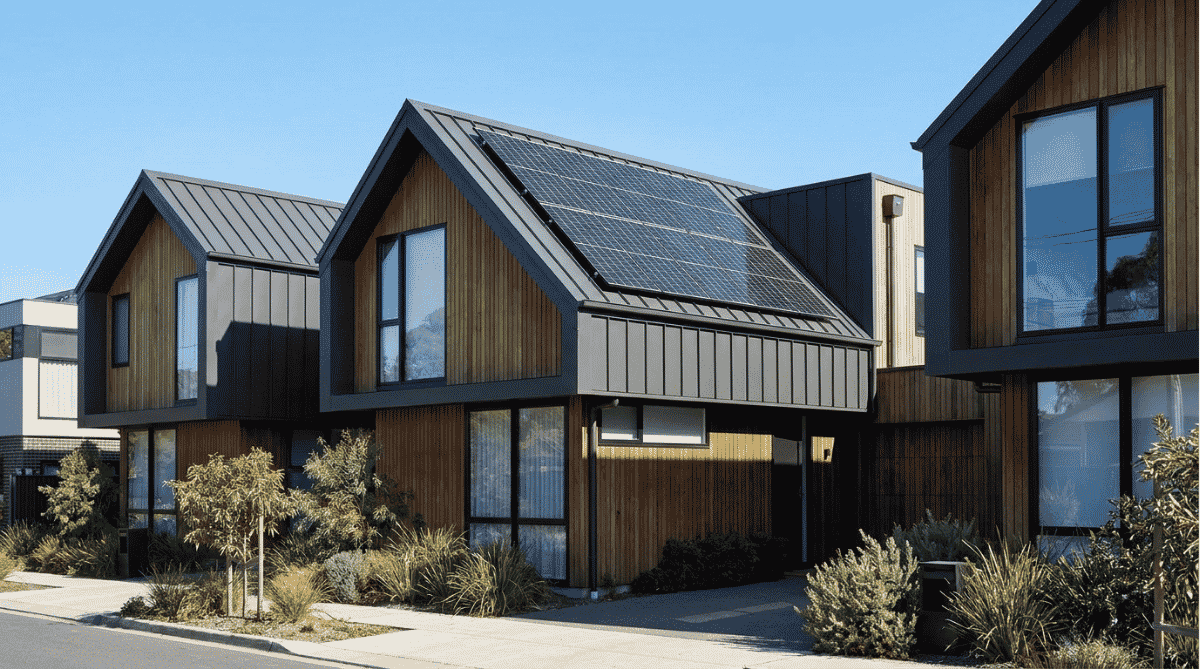
Solar for a townhouse in Australia comes with a reputation for being too hard. Roof too small, strata rules too restrictive, body corporate too difficult — that’s the line too many townhouse owners hear when they start asking. The result is that owners across Sydney, Melbourne, and Brisbane often pay full retail electricity prices while their freestanding-house neighbours sit on $300/month savings.
That’s a frustrating gap. But it’s also closing. Townhouse solar is more doable in 2026 than ever — you just have to plan more carefully than your detached-house neighbour did.
This guide walks through what fits, what doesn’t, and the paperwork most installers won’t warn you about until after you’ve signed.
Can You Install Solar on a Townhouse in Australia?
Short answer: yes, in nearly every case. The barriers are usually administrative, not technical.
Three things determine whether your townhouse can host solar:
Roof access. If you own your section of the roof outright (most modern townhouses), you can install. If the roof is “common property” under your strata plan, you’ll need body corporate approval and possibly an agreement on how the roof space gets used.
Useable surface area. A townhouse roof is often 30–60 square metres of useable space — half what a freestanding home has. That cuts your maximum system size, but doesn’t rule solar out.
Shading from neighbours. Townhouse rows can shade each other, especially in winter. An installer should do a basic shade analysis, not just look at Google Maps.
If you live in a duplex or semi-detached townhouse with your own metered roof, you’re usually treated like a freestanding home for solar purposes.
How Much Roof Space Do You Actually Need?
Each kilowatt of solar needs roughly 4–5 square metres of roof. So:
- 3kW system: ~12–15 m²
- 5kW system: ~20–25 m²
- 6kW system: ~26–33 m²
Most Australian townhouses can host a 3–5kW system comfortably. A few with larger flat or near-flat roofs can fit 6.6kW. If your useable space is below 12 m², you may be looking at a smaller dedicated battery setup with grid topping rather than full solar.
Quick reality check: don’t include sections of roof shaded by your neighbour’s chimney, your own air conditioning unit, or anywhere too close to a roof edge. Installers won’t mount panels in those spots, even if your tape measure says they fit.
Strata, Body Corporate, and Council Approvals (The Paperwork)
This is where most townhouse solar projects stall. Three layers of approval often apply:
- Strata or body corporate. If your roof is common property, you need committee approval. Some bodies corporate have already passed by-laws permitting solar (especially in NSW and VIC after recent reforms); others still vote case by case. Submit a written proposal with installer details, system size, panel placement, and a clean handover plan.
- Council approval. Most councils don’t require specific solar approval if the system meets standard installation rules. Heritage zones and certain inner-city councils are exceptions — Melbourne CBD and Sydney Inner West have stricter visual rules.
- Grid connection. Your retailer and DNSP (distribution network) approve the connection. This is mostly paperwork your installer handles, but in dense townhouse rows the local network can occasionally cap export limits, meaning you can install a 5kW system but only export 3kW back to the grid. Worth checking.
A real-life example: imagine a NSW townhouse owner who books a 5kW install in March. They sign the contract in April, get strata approval in late May, council clearance in early June, and finally go live in July. Four months. So if you want solar by summer, plan early.
Right-Sizing Solar for Townhouse Energy Use
Townhouses tend to use less power than freestanding homes — they’re smaller, often better insulated, and usually share at least one wall (which cuts heating and cooling loads significantly). Typical daily use:
- 1–2 person townhouse: 8–14 kWh/day
- 3–4 person townhouse with aircon: 14–22 kWh/day
For most townhouse households, a 3–5kW solar system covers daytime use comfortably and produces a small evening surplus. If your roof can fit 6.6kW and you’ve got the household demand, even better.
The maths gets more interesting once you add a battery — which we’ll cover next.
Battery in a Townhouse — Where It Goes and Why It Matters
Townhouse owners often skip batteries because they assume there’s nowhere to put one. Worth correcting: modern home batteries are wall-mountable units roughly the size of a slim wardrobe. Common installation spots:
- Garage wall (most common)
- Side of the laundry
- External wall in a sheltered position
- Inside a utility cupboard with adequate ventilation
Body corporate approval is usually needed for visible external installations. Inside-the-garage installs usually don’t need approval unless your strata explicitly says otherwise.
Why does battery matter more in a townhouse? Because your solar system is smaller, every kWh of generation matters more. Without a battery, that 1pm production goes to the grid for 5–8 cents. With a battery, it stays for your 7pm use, replacing electricity you’d otherwise buy at 35–45 cents. The smaller your system, the more important storage becomes for the economics to work. For broader sizing rules across all home types, our guide to the best solar system for a 3 bedroom house covers the kW-to-kWh sizing logic in detail.
How is Tesseract ZERO different in this regard?
Tesseract ZERO works for many townhouses where the standard freestanding-home model fits — meaning roof access is yours, you’ve got around 30 m² of useable surface, and your strata or body corporate is open to solar. The standard package is 6.6kW solar + 20kWh battery + Power Backup Gateway, installed at $0 upfront with maintenance covered for 10 years. For townhouse owners, the no-upfront structure removes one of the biggest barriers — you don’t have to fund the install yourself while waiting on strata approval. Smaller-roof properties may need a custom package, which we can scope during a free site assessment.
Conclusion
Solar for a townhouse in Australia isn’t impossible — it just requires you to think about three things your freestanding neighbours don’t: useable roof, strata or body corporate approvals, and right-sized storage. Get those right and your bills can drop just as much as theirs.
If you’d like to know whether your specific townhouse can host solar, book a free site assessment — we’ll review your roof, your strata setup, and the maths in one go.
For homeowners weighing different installer options before committing, our next post covers how to choose a solar installer in Australia — including the nine questions that filter out cowboys and weak warranties.
Frequently Asked Questions
Do I need body corporate approval for solar on my townhouse?
If your roof is common property under the strata plan, yes. If your roof is exclusive use or owned outright, usually no — though some bodies corporate require notification anyway. Check your strata plan or ask your strata manager.
What’s the smallest worthwhile solar system for a townhouse?
A 3kW system is usually the practical minimum. Below that, the install cost per kW gets disproportionately high, and the savings get marginal compared to what you’d save by switching to a cheaper retailer instead.
Can I take my solar system with me when I sell my townhouse?
You can technically remove and reinstall it, but it’s rarely worth the cost (around $1,500–$3,000 in labour). Most owners leave the system as a property selling point. With Energy-as-a-Service plans, the contract usually transfers to the new owner instead.