
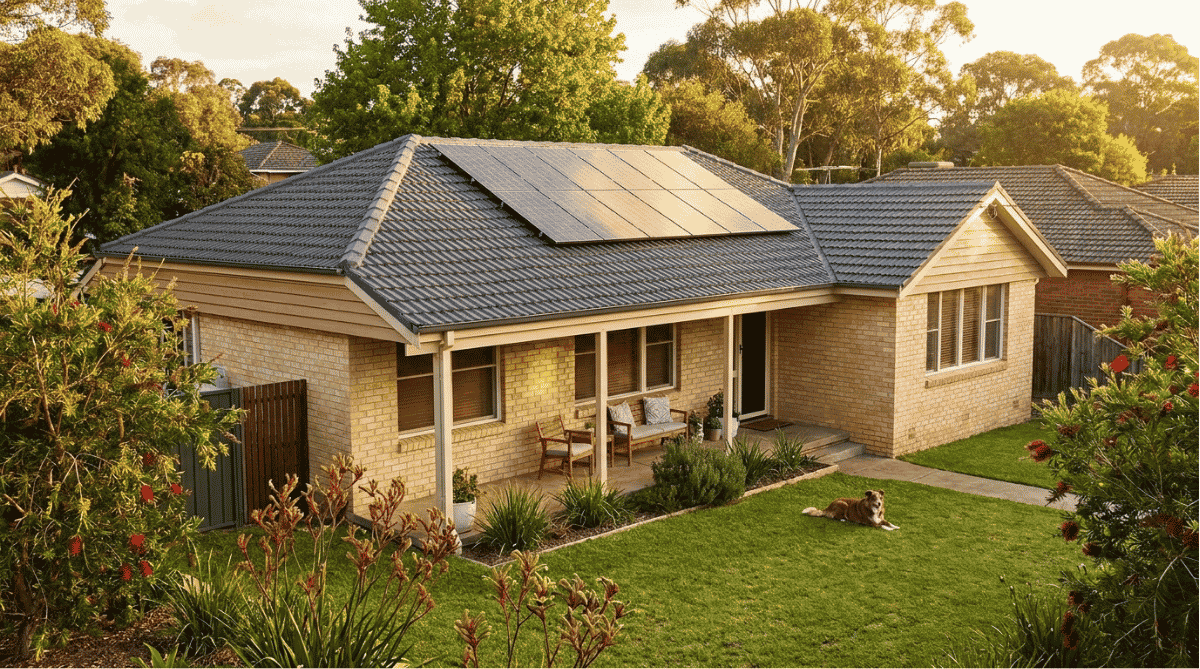
Working out the best solar system for a 3 bedroom house in Australia usually comes down to one underlying question: how do you cover your household’s actual energy use efficiently, without paying for capacity you’ll never need? A four-person family in Sydney, Brisbane, or Adelaide typically uses between 20 and 30 kWh of electricity a day — and that number is the foundation for any sensible sizing answer.
This is the right question. Most online quotes default to “6.6kW” without ever asking how big your home actually is — which is a bit like a tailor selling you a size 32 suit before measuring you.
Here’s how to size it properly, what it should cost, and what most installers won’t tell you. If you’re still working out the cost picture overall, our guide on solar energy cost in Australia covers panel and battery pricing by state.
How Much Power Does a 3 Bedroom House Actually Use?
The headline number depends on three things: how many people live there, what appliances run, and which state you’re in (climate matters more than people realise).
Average daily usage by 3 bedroom household type:
- 2 working adults, no kids, no aircon: 12–16 kWh/day
- 2 adults + 2 kids, ducted aircon used in summer: 22–30 kWh/day
- Working from home, electric hot water, EV charging: 28–40 kWh/day
So before you compare any systems, look at your last four power bills and divide total kWh by total days. That number is the foundation for everything else.
A small but useful tip: Australian summer power use is roughly 1.5x winter use in QLD/NSW, and roughly the inverse in VIC/TAS due to heating loads.
What Size Solar System Suits a 3 Bedroom Home? (kWh + kW)
Once you know your daily usage, the rule of thumb is straightforward:
System size (kW) ≈ daily usage (kWh) ÷ 4 (rough average sun-hours)
So a household using 24 kWh a day needs about a 6kW solar system to break even on energy production. But “break even on production” isn’t the same as “cover your usage from solar” — because a chunk of your usage happens at night.
That’s where battery sizing comes in. Most 3 bedroom households need 10–15 kWh of storage to cover evening loads on a typical day. If you’ve got teenagers, gaming setups, or run an EV, push that to 18–20 kWh.
For most 3 bedroom houses across QLD, NSW, VIC, and SA, the answer lands somewhere between:
- 6kW solar + 10kWh battery for moderate users
- 6kW solar + 13–20kWh battery for higher-use households
6.6kW vs 10kW — Which Makes Sense for Your Bills?
This is the most common question we hear. Bigger system means bigger savings, right? Sort of.
A 6.6kW system on a 3 bedroom roof generates roughly 25–28 kWh on a sunny day in southeast Queensland. A 10kW system generates 40–44 kWh. If your household only uses 24 kWh, that extra 15 kWh from the bigger system goes to the grid at a low feed-in tariff (typically 5–8 cents in 2026).
So unless you’re charging an EV, running a pool pump on long cycles, or planning to add electric heating, a 10kW system often doesn’t earn its extra $1,500–$2,500 cost back. The exception: if you have the roof space and a battery, a bigger system stores more for evening use, which changes the maths.
Here’s a real-life check. Picture a Brisbane family of four. Ducted aircon running 4-5 months a year. Two kids glued to gaming consoles, two laptops in use during the day. Their 25 kWh average is fine on a 6.6kW system. The same family with an EV doing 250km a week jumps to 38 kWh — and now needs the bigger system, plus more battery.
Which one are you?
Do You Need a Battery? Honest Answer for 3 Bedroom Households
Three years ago the answer was usually “no, batteries are too expensive.” In 2026 that’s flipped. Federal rebates cut battery prices by about 30%, feed-in tariffs are tiny, and grid prices keep climbing.
The honest answer for a 3 bedroom household:
- You’re home most of the day: smaller battery (10kWh) is fine, savings are still good
- You’re empty 8am–5pm and use most power at night: battery is essential, otherwise solar economics get weak
- You want backup power during blackouts: you need a battery + a backup-capable inverter
Without a battery, a typical 3 bedroom household captures maybe 30-40% of its solar production directly. With a battery, that jumps to 75-90%. That’s the difference between a $1,500/year saving and a $2,500/year saving on the same system — roughly an extra $80 a month back in your pocket.
What “Best” Really Means: Panels, Inverter, Warranty, Installer
The best solar system for a 3 bedroom house in Australia isn’t a brand list — it’s a combination of decisions. Use this checklist when comparing quotes:
- Tier-1 panels with at least 25-year performance warranty
- Reputable inverter (Fronius, SMA, Sungrow, GoodWe) with 10-year warranty
- CEC-accredited installer (this is non-negotiable for rebate eligibility)
- Workmanship warranty of at least 10 years
- Battery from a manufacturer with an Australian-supported warranty (not a brand that disappears in two years)
- Clear answer to “who pays for inverter replacement in year 9?”
If a quote skips any of these, ask why before signing.
Tesseract ZERO is sized exactly for the household this article describes. The standard package is 6.6kW solar + 20kWh battery + a Power Backup Gateway for blackout protection — installed at $0 upfront, with all maintenance and inverter risk handled by us, at a fixed $0.28/kWh for 10 years through our retail partner. For a 3 bedroom house using 22-30 kWh a day, that 20kWh of storage covers most evenings without dipping into the grid, and the fixed price means you’re not exposed to retail tariff hikes when the AER signs off on the next round of increases.
Conclusion
The best solar system for your 3 bedroom house isn’t the biggest, the cheapest, or the brand with the slickest ad. It’s the one sized to your actual usage, paired with enough storage to cover your evenings, installed by someone who’ll still be around in year nine when something needs attention.
If you’d like a sizing recommendation specific to your address, usage, and roof, book a free consultation — we’ll work through your last four bills and show you what fits.
If you live in a townhouse rather than a freestanding home, our next post on solar for a townhouse in Australia covers the trickier sizing rules that apply to smaller roofs and shared walls.
Frequently Asked Questions
Is 6.6kW enough for a 3 bedroom house?
For most 3 bedroom households using 18–30 kWh a day, yes. If you have an EV, ducted aircon running daily, or electric heating, you may need 8-10kW. The trick is matching system size to actual usage, not assumed usage.
How long does a solar system for a 3 bedroom house take to pay back?
On owned systems with a battery, payback is usually 5-8 years in QLD/NSW/SA, slightly longer in VIC and TAS. Without a battery, payback is faster (3-5 years) but ongoing savings are smaller.
Can I add a battery later if I install solar now?
Yes, but you’ll need a battery-ready (hybrid) inverter for it to work cleanly. If you’re not adding the battery now, ask the installer to use a hybrid inverter so you don’t pay twice when storage prices drop further.