📋 In this guide:
- Hybrid solar system in Australia: links panels, battery and grid
- Hybrid inverters let you add storage without rewiring later
- Best suited to homes with high evening or backup needs
- Costs more upfront than a basic grid-tied system
- Tesseract ZERO ships a hybrid 10kW inverter as standard
A hybrid solar system Australia homeowners choose in 2026 sits between two older approaches: the basic grid-tied setup that sends excess power to the grid, and the fully off-grid system that cuts the cord completely. A hybrid does both jobs. It runs your home on solar, stores the extra in a battery, and stays connected to the grid as a backstop. For a lot of Australian households in 2026, that middle path is the one that actually makes sense.
But “hybrid” gets thrown around loosely in quotes and ads, and it’s worth knowing exactly what you’re paying for. Is it just a battery? Is it a special inverter? Does it keep the lights on in a blackout? The answers decide whether a hybrid setup is right for your home or an expensive feature you won’t use.
This guide explains what a hybrid system actually is, how it compares to the alternatives, what it costs, and the kind of household it suits.
What Is a Hybrid Solar System?
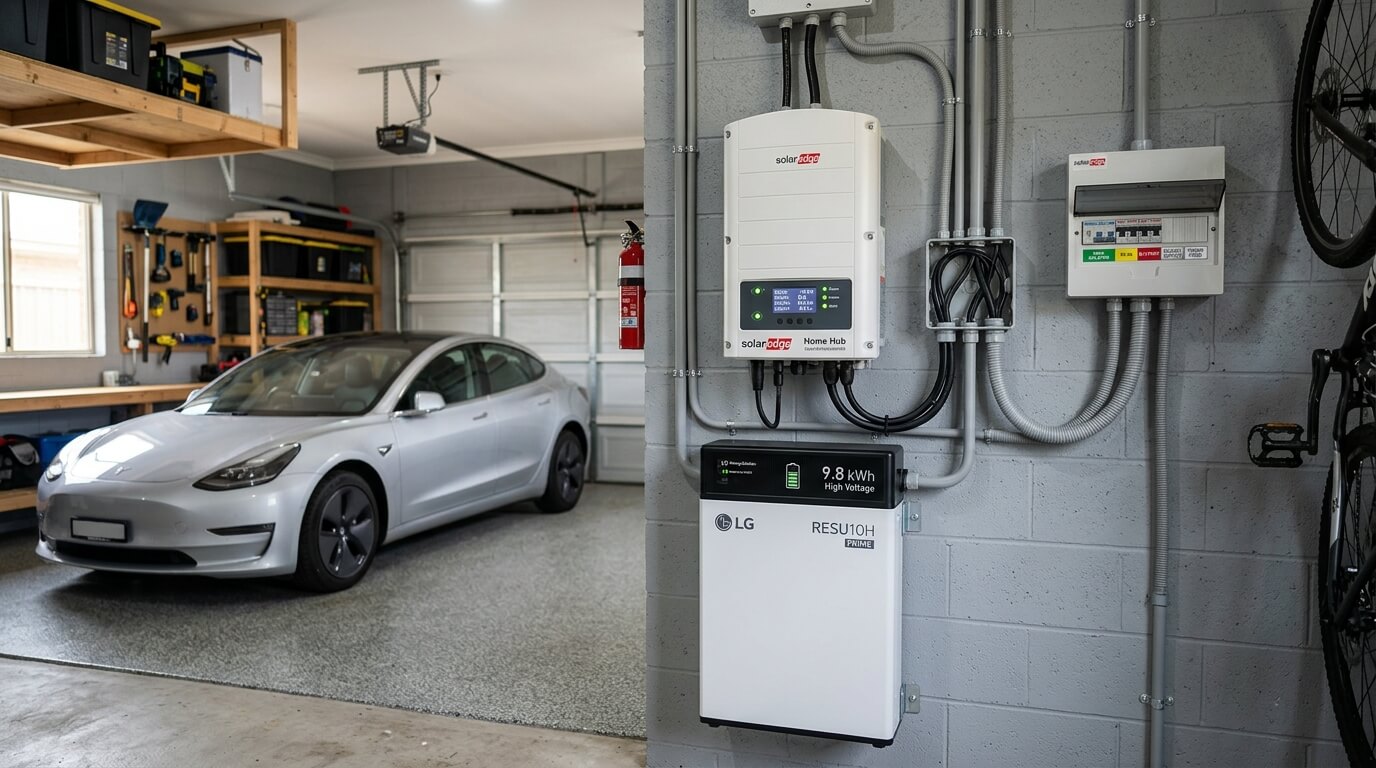
A hybrid solar system is solar panels plus a battery plus a hybrid inverter, all still connected to the grid. The inverter is the clever part. A hybrid inverter can send power three ways: straight to your home, into the battery, or out to the grid, and pull from the battery or grid when the sun isn’t shining.
That’s different from a basic grid-tied system, where solar only powers the home or exports to the grid, with no storage. It’s also different from off-grid, where there’s no grid connection at all and the battery has to carry everything.
The “hybrid” bit means you get the flexibility of storage and the safety net of the grid at the same time.
Hybrid vs Grid-Tied vs Off-Grid: Quick Comparison
Grid-tied (no battery). Cheapest to install. Solar powers the home during the day, excess exports to the grid. At night you buy grid power. No blackout protection. Best when your usage matches daylight hours.
Hybrid (battery + grid). Stores daytime solar for evening use, stays grid-connected for backup and top-ups. Often includes blackout protection if the inverter supports it. Costs more upfront but captures far more of your solar. Best for evening-heavy homes.
Off-grid (no grid). No connection, no bills, but you carry all the risk and need a much larger battery. Usually only worth it where a grid connection is genuinely expensive or unavailable.
For most suburban Australian homes with a grid connection already at the street, hybrid is the practical winner.
What a Hybrid Setup Costs in Australia
A hybrid system costs more than grid-tied solar because you’re adding a battery and a more capable inverter. The battery is usually the single biggest line item. Prices vary widely by battery size, brand and your state’s rebates, so a quote is the only honest number, but expect a hybrid setup to sit meaningfully above a panels-only install.
The cost question to ask isn’t just “how much,” though. It’s “how much of my solar will this let me actually use?” A hybrid system that lifts your self-consumption from 35% to 85% is doing real financial work every single day, and that’s what pays the extra cost back.
Who Should Actually Get a Hybrid System?
Be honest about your day. A hybrid setup earns its keep if any of these sound like you.
Your home is empty during the day but busy at night, so your solar would otherwise export at low feed-in rates instead of running your evening. You live somewhere with regular outages and want the lights to stay on. You’re planning an EV or electric hot water, which adds evening load a battery can cover. Or you simply want predictable bills instead of riding grid price rises.
If, on the other hand, someone’s home all day running the big appliances under the midday sun, a simpler grid-tied system might cover most of your value already. The setup should match the life, not the other way around.
A Real-Life Scenario: The Empty-House Weekday
Picture a Perth couple, both at work 8am to 6pm, kids at school. Their old grid-tied system generated plenty at midday and exported almost all of it at 6c, then they bought it back at 40c when they got home and switched everything on. They were effectively donating their best solar to the grid.
They switched to a hybrid setup. Now that midday generation fills the battery, and the battery runs the evening, the aircon, the cooking, the laundry, the chargers. Their grid imports dropped sharply, and a storm-season blackout last winter didn’t even interrupt dinner. Same roof, same sun, completely different result.
Would that change anything about your evenings? For a lot of households, it’s the difference between solar that half-works and solar that actually pays.
Where Tesseract ZERO Fits In
Tesseract ZERO is a hybrid system by design. The standard package combines 6.6kWp of solar with a 20kWh battery and a hybrid 10kW inverter, plus a Power Backup Gateway for blackout protection. The 20kWh capacity is larger than the 10–13kWh most competitors fit, which matters as evening loads grow. Because it’s offered at $0 upfront with $0 maintenance and a fixed $0.28/kWh for 10 years through the Tesseract retail partner, you get the hybrid setup without the upfront cost that usually makes people hesitate on the battery.
The Bottom Line
A hybrid solar system in Australia gives you storage and grid backup together, which suits the way most homes actually use power, heavy in the evening, exposed to blackouts, and tired of rising bills. It costs more than basic grid-tied solar, but it captures far more of your generation and adds resilience the cheaper option can’t. The deciding factor is your daily rhythm: evening-heavy homes gain the most.
Not sure which setup fits your home? Book a free assessment and we’ll match a system to how you actually use power.
For more on the storage side, see solar + battery for modern Australian homes and our solar battery vs no battery guide. Next in this series we compare on grid vs off grid solar.
Frequently Asked Questions
What’s the difference between a hybrid and a grid-tied solar system?
A grid-tied system has no battery: solar powers your home or exports to the grid, and you buy grid power at night. A hybrid system adds a battery and a hybrid inverter, so daytime solar is stored for evening use, with the grid still there as backup. Hybrid usually also enables blackout protection.
Does a hybrid solar system work during a blackout?
It can, but only if the inverter and setup support backup mode, often with an additional switching device. Not every hybrid install includes this by default, so ask the installer specifically whether the system keeps running during a grid outage and which circuits stay powered.
Is a hybrid solar system worth the extra cost in Australia?
For homes that use most of their power in the evening, usually yes. The extra cost buys much higher self-consumption of your own solar, which is worth far more than exporting it at low feed-in rates, plus optional blackout protection. For homes that use most power during the day, a simpler system may be enough.
How is Tesseract ZERO different?
Clean energy made at your home, without buying the system.
Tesseract installs, owns and maintains solar and a battery at your home. You pay only for the clean energy you use, at one fixed rate for 10 years.