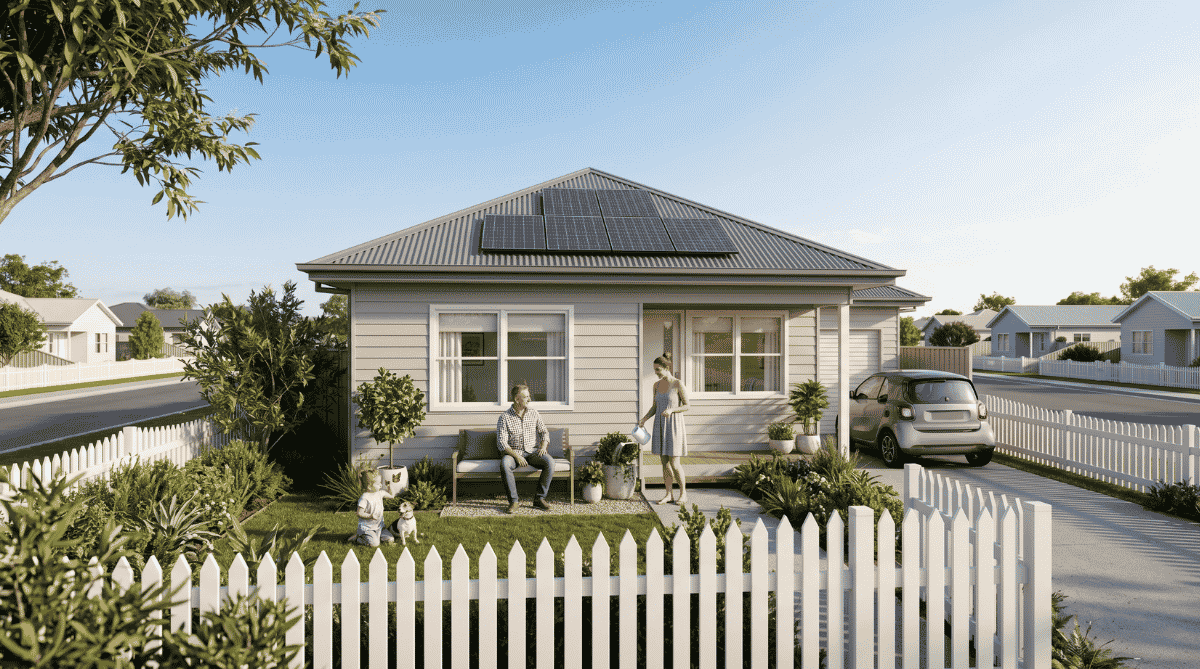
Solar panels for a small house in Australia often get treated like an afterthought. Big-house owners get the glossy 20-panel quotes. Small-house owners get told “you don’t use enough power to bother.” That’s mostly nonsense — small homes can see strong solar economics, sometimes faster than larger homes, as long as the system is sized correctly.
This guide walks you through what fits on a small Australian home (1-2 bedrooms, granny flats, retired couples in a downsized home), what the system should realistically cost, and how to avoid being sold a 6.6kW system you’ll never fully use.
What Counts as a “Small House” in Australia?
For solar purposes, “small” usually means one of these:
- A 1-2 bedroom freestanding home (often 80–120 m² floor area)
- A granny flat or secondary dwelling on a larger block
- A downsized retirement home for 1-2 occupants
- A compact older home built before the 1980s expansion era
These homes typically use 7–18 kWh of electricity a day — about half of what a 3-4 bedroom family uses. So when we talk about sizing solar for a small house, we’re aiming at a smaller daily load and usually a smaller roof.
How Many Solar Panels Does a Small House Need?
The maths is simpler for small homes than for big ones. Two figures matter:
Daily usage (kWh from your last four bills divided by total days) Roof orientation (which way your useable surface faces)
Typical small-house sizing:
- 1 occupant, no aircon: 6–10 kWh/day → 2–3kW system (about 5-8 panels)
- 2 occupants, occasional aircon: 10–15 kWh/day → 3–5kW system (8-13 panels)
- 2 occupants, daily aircon, EV charging: 15–25 kWh/day → 5–6.6kW system (13-17 panels)
Each modern panel is roughly 400-450W. A 3kW system uses about 7-8 panels and takes around 15 m² of roof space. A 5kW system needs around 25 m².
Here’s where small-house solar gets interesting. Because the federal STC rebate is generous in the 4-6.6kW range, sometimes a 5kW system costs barely more than a 3kW system after rebates. If you’ve got the roof space, the bigger system often makes more sense even for a small home.
What Does It Actually Cost?
Installed pricing in 2026, after STCs, for small-house solar:
- 3kW system: $3,500–$5,500
- 5kW system: $4,500–$7,000
- 6kW system: $5,500–$8,500
These are panel-only prices. Adding a 10kWh battery brings the total up by another $6,000-$9,500 after the federal battery rebate.
If your quarterly bill is under $200, even a 3kW system may struggle to pay back in under six years without a battery — your usage is too small to capture much value. If your quarterly bill is over $400, almost any sized system pays back within 4-5 years.
For broader context on system pricing, our solar energy cost in Australia guide breaks down the components by state.
Do You Need a Battery for a Small Home?
This is the question more small-house owners are asking in 2026 than ever.
Picture this: it’s a Wednesday morning, 7:30am. You’ve just got out of the shower. The kettle’s on. The bathroom heater ran for ten minutes. None of this happened with solar, because the sun isn’t generating yet. If you’d had a battery, that morning energy would have come from yesterday’s surplus. Without one, you bought it from the grid at 35-45 cents per kWh.
For small homes that are empty during the day (single occupant working out of the home, retiree at the community centre, holiday property), batteries are often a bigger economic win than they are for larger homes. Why? Because the percentage of your generation that you’d otherwise sell back to the grid at 5-7 cents is much higher when your daytime usage is low.
A few sanity checks:
- You’re home all day, low aircon use: battery is optional, solar alone works fine
- You’re empty 9am–5pm and use most power in the morning and evening: battery shifts the maths significantly
- You want backup power during storms: battery is essential
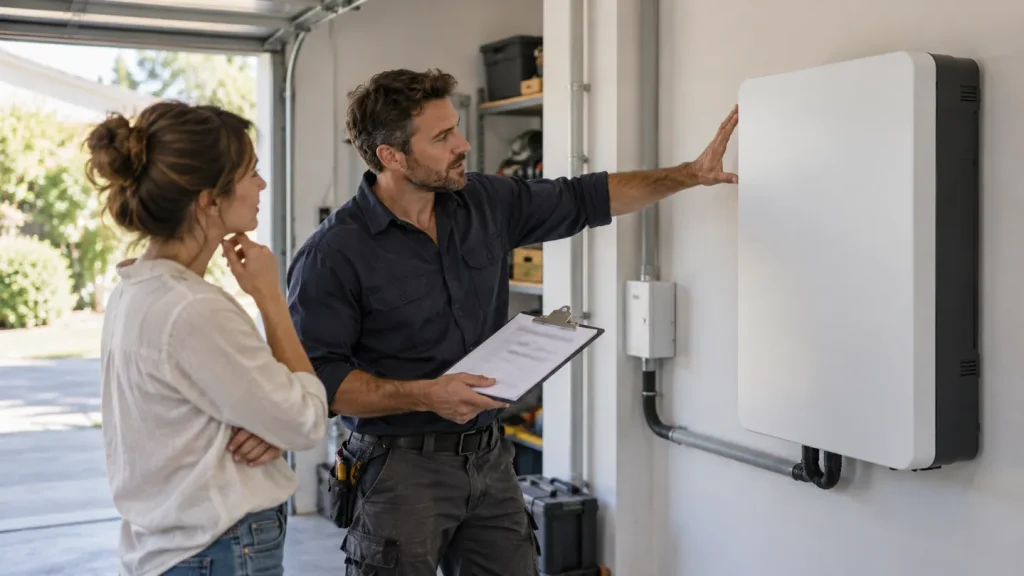
For a 1-2 person small home, a 10kWh battery is usually plenty. Bigger isn’t always better — battery cost-per-kWh-stored is what matters, not absolute capacity.
What About Strata, Apartments, and Townhouses?
If you’re in a small standalone house, your install path is straightforward. If you’re in a unit, apartment, or townhouse, the rules change.
Strata-titled small homes (including most modern townhouses) need body corporate approval if the roof is common property. Apartments often can’t host individual rooftop solar at all, though embedded networks and shared solar schemes are slowly changing this.
For townhouse owners, we’ve covered the specifics in our solar for townhouse Australia guide.
Where Tesseract ZERO Fits In
Tesseract ZERO is built around a 6.6kW solar + 20kWh battery package, which often sits on the larger end of what a small home actually needs. For some small-house owners that’s overkill — but for retirees with reverse-cycle aircon running 6 months a year, two EVs in the garage, or a small home being used as a future-proofed primary residence, the bigger battery is a feature rather than waste. It’s installed at $0 upfront, $0 maintenance, fixed $0.28/kWh for 10 years through our retail partner. If your small-home usage is closer to 8 kWh/day, a smaller owned system might suit better. If you’re 15+ kWh/day and want certainty, we’re worth comparing.
The Bottom Line
Solar panels for a small house in Australia can pay back faster than people assume — but only if the system is sized to your actual usage, not the installer’s default 6.6kW quote. Look at your last four bills. Work out your daily kWh. Match the system to that number, with some headroom for a future battery or EV.
If you’d like a sizing recommendation specific to your small home, book a free assessment and we’ll work it out from your bills.
If your property is a rental rather than your primary home, our next post on solar panels for rental property in Australia covers the different economics and tax treatment for landlords.
Frequently Asked Questions
Is a 3kW solar system enough for a small house?
For a 1-2 person small home using 6-12 kWh a day, yes. A 3kW system in Brisbane or Adelaide generates roughly 12-13 kWh on a sunny day — enough to cover daytime use comfortably. If you use aircon daily or charge an EV, you’ll need 5kW or more.
How long does solar take to pay back on a small house?
Without a battery, 3-5 years for most small Australian homes with quarterly bills over $300. Add a battery and payback stretches to 5-8 years, but ongoing savings are higher and you’re insulated from grid price rises. Smaller bills mean longer payback.
Can I install solar on a small home if I rent it out part-time?
Yes, but the tax treatment changes. If the property is rented or used as an Airbnb for part of the year, you may be eligible to claim depreciation on the solar system as a rental-property capital expense. Talk to your accountant before installing — the maths can shift significantly.
How is Tesseract ZERO different?
Clean energy made at your home, without buying the system.
Tesseract installs, owns and maintains solar and a battery at your home. You pay only for the clean energy you use, at one fixed rate for 10 years.